3rd July 2026
Conjectures and Tasks
If an experienced mathematician has thought about a problem for some time without being able to solve it, he or she can pass it on to colleagues as a conjecture or open question. There are thousands of such conjectures. Very few are world-famous, while most of them are known only to a few experts. Solving a conjecture or answering an open question, whether big or small, is always a special moment. I know that feeling. Solving one’s own conjectures, however, is a different matter entirely; it raises the suspicion that one simply hadn't thought enough at the start. Keep this in mind.
What does all this have to do with the study presented here? A lot. This study is essentially a mathematical proof of existence. This study is not a work of art. I formulated a problem as a task in chess composition almost a year ago (see here). It was formulated as a fun task, and so it belongs to the field of recreational mathematics too. However, the circumstances that led to the formulation of the task are a bit more serious. First, let me briefly present the task and its solution, and then outline that background.
The task: "Compose a study that
- begins with all pieces (i.e., queen, two rooks, two bishops, and two knights for each side) and a legal number of pawns,
- reach a pawn endgame, and
- the mainline of the solution must not have any consecutive captures."
And here its first solution.
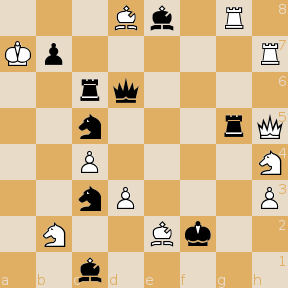
White to move and win.
Not a game-like starting position, isn't it.
1. Nd1+ Ke1 2. Nf3+ Kxe2 3. Nd4+ Ke1 4. Rxe8+ Be3 5. Rxe3+ Kd2 6. Re2+ Kxd1 7. Re1+ Kxe1 8. Re7+ Qxe7 9. Qh4+ Kd2 10. Nxc6 Qd6 11. Bxg5+ Kc2 12. Qf2+ Kxd3 13. Qd2+ Kxc4 14. Na5+ Kb4 15. Qxd6 Nb5+ 16. Kb6 Nxd6 17. Bd2+ Ka4 18. Kxc5 Ne4+ 19. Kd4 Nxd2 20. Ke3 Nf1+ 21. Kf4 $1 Kxa5 22. h4 Ng3 !? 23. Kxg3 and White wins by 23... b5 24. h5 b4 25. h6 b3 26. h7 b2 27. h8=Q b1=Q 28. Qa8+ Kb4 29. Qb7+ Kc3 30. Qxb1 1-0
You can play through the moves online here at Arves. I don't think you should go through these moves any way other than in fast-forward. There is nothing to be learned from the sequence. Engine checking is required to proof correctness. No big overall idea. The potential scope for artistic content that I had mentioned when I set up the task was not utilized. And now I believe that in all likelihood, this scope does not exist, or is very difficult to unlock.
There is just one small detail worth mentioning: The final piece, a black knight, is leaving the board with a winkle (22.. Ng3). Remember: it's a fun task!
I wonder what a casual visitor to that Arves page might think about the composer and the judge. A 2nd honorable mention for what? No explanation, no comment, just this massacre.
When I defined the task, I wrote: "In recent months, I have had the impression that captures become more and more common. Eventually, I turned it into a concept [..]."
The impression appeared several times with whole tournaments. In many studies, material disappeared from the board in large quantities. I don't like that. It was a great relief when later I came across the following sentence in an article by Serhiy Didukh on his ChessStudy.art web-page (defunct):
"Economy is paramount." Thank God! This rule is still in effect!
One day, I was trying to create a parody of such studies: capture, capture, capture, and another capture, and then a capture and a capture and so on. It worked out, but it wasn't funny. I remembered a study by Vladimir Tarasiuk, who first exchanged queens, then rooks, then bishops and finally knights. What could be a useful restriction for me? A discussion at ChessStudy.art on bad captures, i.e. two consecutive captures on the same square, had a deep impact to me one or two years earlier. This discussion ended with a question by Steffen Nielsen, who asked about the value of consecutive captures. This eventually led me to formulate condition 3. The parody aspect went out of sight (good!) and a real challenge was set up (even better!) while the funny facet was still there.
Well, I have to admit that I was close to a solution quite quickly—even when I published the task. And I finished the above solution a short while later. But I had no ambitions to publish my own solution - that would be like solving your own conjecture!
Months passed. Then I read the following about the Gatti 10 Anniversary JT: "The judge finds beauty even in chaos, and is personally drawn to compositions with drama, wit or a touch of humour, more than to those of strict formal perfection and adherence to conventions. Be bold with your best creative and original ideas!"
The above mentioned discussion about bad captures was begun by no other than Daniele Gatti. That, along with the description of the desired studies, convinced me to submit this study (together with a serious one!) to his tourney.
And now, the floor is Daniele's (from his fantastic award):
"This study is built around an unusual compositional challenge rather than around
a single tactical idea. Starting from an almost complete set of pieces, apparently placed randomly, the Author gradually and deliberately
transforms the position into an elementary pawn endgame while rigorously avoiding any consecutive captures in the main line. The so-called "bad
captures". Piece after piece leaves the board until Black sacrifices the very last one, almost humorously announcing that the intended pawn ending has finally been
reached. The study therefore possesses a clear narrative character, with every exchange contributing to the same long-term objective. No sidelines, nothing really
complex:
all you can find here is a manifest of coherence to a witty idea.
The central play inevitably becomes somewhat mechanical, as the thematic constraint governs much of the construction, and the final pawn endgame is more functional
than surprising. Nevertheless, the originality of the underlying concept, together with its remarkably consistent execution, makes the study memorable and gives it an
artistic identity of its own.
I'm afraid I smiled a second too long, when watching it. And probably the reason is the explanation the Author gives in his accompanying e-mail:
"Do you remember that you asked on chessstudy.art something like "what is a bad
capture?". I read that discussion many times. I even dropped some of my studies, because
they contained a bad capture. That old discussion ended with a question by Steffen, how
consecutive captures are considered. Are they bad, too? Probably not. Nevertheless I
transferred the idea almost one year ago on my website into a fun task: "Compose a study
that begins with all pieces [...]".