2nd July 2026
Child of sorrow
The German word "Sorgenkind" is hard to translate, in particular if it is not used for a real child, but for a thing. Problem child, my troublesome child, labor of worry and so on are suggested by the AI. Child of sorrow is my choice. It has a melancholic tone, says the AI, poetical and emotional heavy. Yes, that comes close in this case.
Three years ago, in May 2023, I spend four weeks with the endgame RP vs BP. I generated all kind of forced variations and studied them. Shortly thereafter I started with study composing and submitted my first study to a tourney (the FIDE World Cup 2023 -- some people will remember). After that first study I thought about RP vs BP again, this time for a study. Although only a few weeks had passed, only one position came to mind. It had made an enormously deep impression on me.
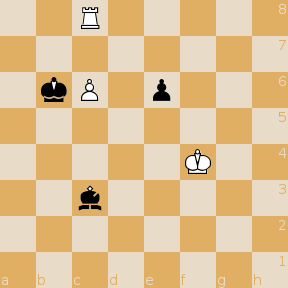
Position 1:
Black to move, White wins.
White is an exchange up, so what's the problem? Well, a bishop's pawn on the 6th rank does not guarantee a win even in the endgame RP vs B!
This is attributed to Domenico Ercole del Rio, and frequently the year 1750 is added, probably because he published his book in that year. I read the English translation of that book and I could not find anything similar. It is well known that Giambattista Lolli studied the R vs. B and RP vs. B endgames extensively, so I assume he referred to del Rio in his 1763 book. However, this remains unverified.
Averbakh and Chéron showed that research continued by including studies by Werner Keym and Pal Benkö from the 1960s in their textbooks.
Once you know that problems can arise, you will appreciate that white can nevertheless win Position 1. Momentarily White's king is cut-off from its own pawn, and the rook is seemingly passive. So how does it work?
It turns out that the long diagonal is too short to give the bishop a safe harbor. Let's see how the play can continue. 1.. Ba1 2. Ke4 Bg7 3. Rg8 Ba1 4. Ra8.
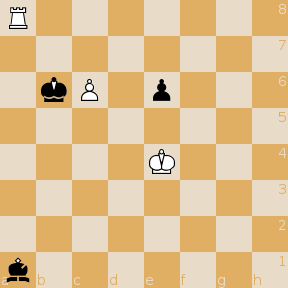
Position 2.
Where does the bishop move? The rook controls a1 and h8, the white king controls d4 and e5. The squares b2 and g7 are taboo tactically (4.. Bg7 5.c7!). And moving to c3 and f6 will lose the pawn.
4.. Bc3. Still the better choice, because Black can try to reach del Rio's draw constellation (Kc7, Be5-h2).
5. Re8 Be1 6. Rxe6 Bg3. Here Black is one move away from saving. Put the black king on c7, and it's the mentioned draw!
7. Rg6 Bh2 8.Rg2 (8.Rh6 Bg3 9. Rh3 Bd6 10. Kd5 only wastes one move.)
8.. Bd6 9.Kd5 and White wins.
If you don't love position 2 with all your heart, then I can only pity you. And this is perfect textbook endgame material. However, to turn it into a study we need an introduction.
The first introduction I created, which I was very excited about for a while, turned out to be so bad that I can't even show it here. A few pieces were added, they all moved, were eventually captured, and this happened only to save the white pawn that had been sitting on c6 the whole time.
This introduction had another flaw, a bad capture. I learned about bad captures only late in 2023 when I read a discussion on ChessStudy.art (defunct). A bad capture consist of two consecutive captures on the same square. So, normal exchanges are bad captures, but also a queen sac like QxPf7+, Kxf7 is a bad capture. That significantly dampened my enthusiasm. Not for this particular study, but for the entire field.
Every few months I would start working on a new introduction. There are indeed numerous possibilities, and certainly dozens of them are worthwhile.
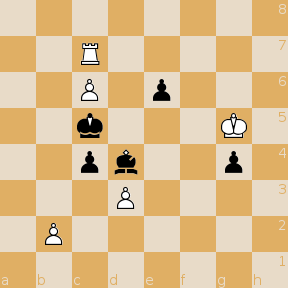
Position 3.
This was my favorite for a long time. Guess the key!
Later I learned from "Endgame labyrinths" by Nielsen & Aagard that the first move of a study is usually not difficult from a solving perspective (Convention #1!!). Man, that hit me hard!
Today I know that bad captures and difficult keys are totally normal and appear even in the studies of their most intense adversaries quite frequently. Got you!
1. Kh5!! Could you drop this introduction? Certainly not because of this key.
1.. Be5 2. d4+! Kb6 3. Rc8 Bxd4 4. Kxg4 c3 5. bxc3 Bxc3 6.Kf4 and we have reached Position 1. The last two moves show the same bad capture I had in the very first introduction, but at this time I didn't care. The reason I reluctantly omitted this introduction is a technical line: 1.. cxd3 2. Rd7 d2 3. c7 d1=Q 4. c8=Q+ Kb5 and though White can stabilize in a much better position, say 5. Qb7+ Ka5 6. Qe4! g3! 7. Kg6! g2 8. Qxg2 Qd3 9. Kf7 Qf5+ 10. Kg8! this lines spoils everything.
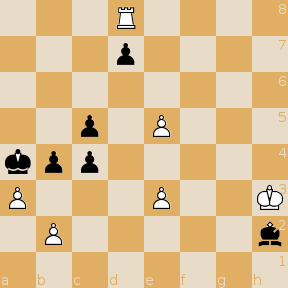
Position 4. (The submitted version)
This became my favorite version at the end of 2025. There is no white c-pawn far and wide. It has to be generated.
1. e6! That coming c-pawn must be a free pawn.
(1. Kxh2? c3 2. bxc3 bxc3 3. e6 dxe6 4. Rd3 Kb3 5. a4 c4 6. Rxc3+ Kxc3 =) (1. axb4? Bxe5 2. bxc5 Bxb2 3. Rxd7 c3 =)
1... dxe6 2. axb4 Bg1 (2... Be5 3. bxc5 Kb5 4. Rc8 c3 5. bxc3 Bxc3 +- )
3. bxc5 Kb5 4. Re8! (4. Rc8? Bxe3 5. c6 Kc5 6. Kg4 Bd2 7. Kf3 Ba5!
8. Ke4 c3 9. bxc3 Bxc3 = See (X) below.)
4... Bxe3 5. c6! Kb6 6. Kg4 Bd4 (6... Bc1 7. Rc8 Bd2 8. Kf3 c3 9. bxc3 Bxc3 10. Kf4 see main.)
7. Rc8! Be5 (7... c3 8. bxc3 Bxc3 9. Kf4 see main.) (7... Kc5 8. c7 Be5 (8... Kc6 9. Rd8) 9. Kf3 Kc6 10. Ke4 Bxc7 11. Kd4 +- )
8. Kf3 c3 (8... Kc5 9. c7 Kc6 (9... Bd6 10. Ke3 (10. Ke4? e5 =) 10... e5 11. Kd2 Kc6 12. Kc3 = e.g. 12... Kc5 13. Rd8 Bxc7 14. Rc8 Kd6 15. Kxc4 ) 10. Ke4 Bxc7 11. Kd4 $18 )
9. bxc3 Bxc3 10.Kf4! and we have reached Position 1 again.
Let's pause a second. What are the pros and cons of this introduction. There are a number of nice tactical shots. Some people cannot live without that. But there is also zugzwang! Yes, just here in Position 1. And I am going to make use of it, though 6-piece zugzwangs have their haters. Here comes the try: 10. Ke4? Kc5 zz (X) 11. Rd8 Ba5 12. Rc8 Bc3 13. Rg8 Kd6 14. Rd8+ Kc7 15. Re8 Be1 16. Rxe6 Bg3 and Black has indeed reached del Rio's draw setup. I think this is one of the better 6-piece zugzwangs. At least it should not damage the whole piece.
There is also a theme we haven't talked about at all. The German Problem composer organization "Die Schwalbe" had recently their 100th anniversary and there was held a thematic tourney with significant money at stake. The theme was the Schwalbe theme: "The essential moves of the main play are played by the same white line piece on one line, but with at least one change of direction."
In my study the thematic line piece is of course the white rook and the Schwalbe theme appears in introduction and the main part: Rd8-e8-c8-g8-a8-e8. However, I didn't dare to participate in this tournament.
I haven’t submitted a study to a magazine for two years. Without particular reason. Instead, I have participated in tourneys where the aim is to show respect to a person. I like to be in the list of participants for this purpose.
First I participated in the Harold van der Heijden 64 JT with this study. Harold acted in accordance with his frequently expressed view that too many studies make it into the awards. That means he did not decorate many studies, including mine, and that was perfectly fine. But what actually ended up in the award remains a mystery to me. I would have loved to read the expert opinions that were previously published on ChessStudy.art.
Then I send the study to the Steffen Nielsen 50 AT. Steffen took the trouble to write a comment on all the rejected studies as well. I really appreciate that! Here are his words regarding my study:
"There are some nice moves initially in this study, but the play then becomes technical in
nature. This study was close to being included in the award. In the end, my lack of interest in
mutual zugzwang probably proved decisive."
That’s one way of looking at it, and that was perfectly fine with me, too.
Third attempt: the Gatti 10th AT. Daniele was the first judge who ever included a study of mine in an award. That's why I absolutely didn't want to miss this tournament. Because of the recent heatwave, I was running late, but I made it in time. And it was so important! No, not because the study finally was awarded something, but because the communication was so incredibly friendly, and a good dose of Daniele’s enthusiasm transitioned to me as I read his very detailed report today!
There are a few outstanding combinations of tourney and award to me, and this one belongs instantly to the top three, maybe taking clear first place once I have seen all the studies and read all of Daniele's comments. If so, he would overtake Steffen Nielsen judging the FIDE World Cup (I think it was the fifth).
Here are Daniele's comments on the study:
"The study gradually transforms from what appears to be a rather classical Rook versus Bishop ending into a remarkably elegant geometrical struggle. White's passed c-pawn is only the starting point; the real battle concerns the control of the long diagonal, where the Bishop initially seems perfectly placed. The artistic highlight comes in the subtle zugzwang sequence beginning with 10.Kf4!, followed by the symmetrical manoeuvre 11.Ke4!, in which Black slowly discovers that the supposedly dominant diagonal is, paradoxically, too short to fulfil its defensive task. The repeated rook manoeuvres enrich the play and fit naturally into the strategic concept, while the ending offers a refined treatment of a well-known defensive setup. Although the study develops through a relatively technical middle phase, its geometrical clarity and the elegant exploitation of reciprocal zugzwangs leave a lasting artistic impression."
I can't complain! Thank you very much.